STEM I, which stands for Science, Technology, Engineering, and Math, is taught by Ms. Curran. In STEM I, we work on our science fair projects.
In my science fair project, I am tried to improve on the current methods of carbon dioxide removal. To remove carbon dioxide,
chemical cycles are used; the cycle I’m worked with is the sodium carbonate cycle. These cycles have a sorbent that can capture carbon dioxide,
and heat can be added to release the carbon dioxide for storage. Instead of using non-renewable energy sources to heat the sorbent,
I am used only the sun and a Fresnel lens to provide the heat needed to release the carbon dioxide.
For our science fair projects, we had to write a research plan,
which is a document that included our goals, our procedures, what we are going to do with our results, and safety information.
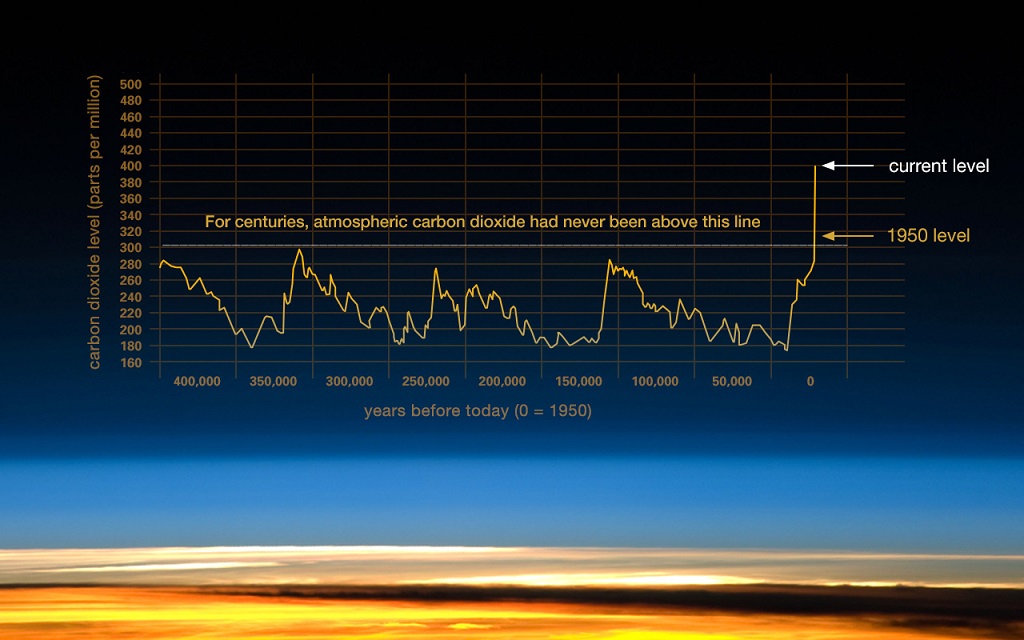
To the left is one of my favorite graphs. It shows the carbon dioxide level in the atmosphere for the past four hundred thousand years.
The graph clearly shows that carbon dioxide levels have been quite unnaturally high lately and that we need to do something about it.
Plus, the graph is quite aesthetically pleasing.
We also had to write a review of literature, which is a paper that summarizes our research in the field that we are studying.
In my review of literature, I wrote about various carbon capture methods,
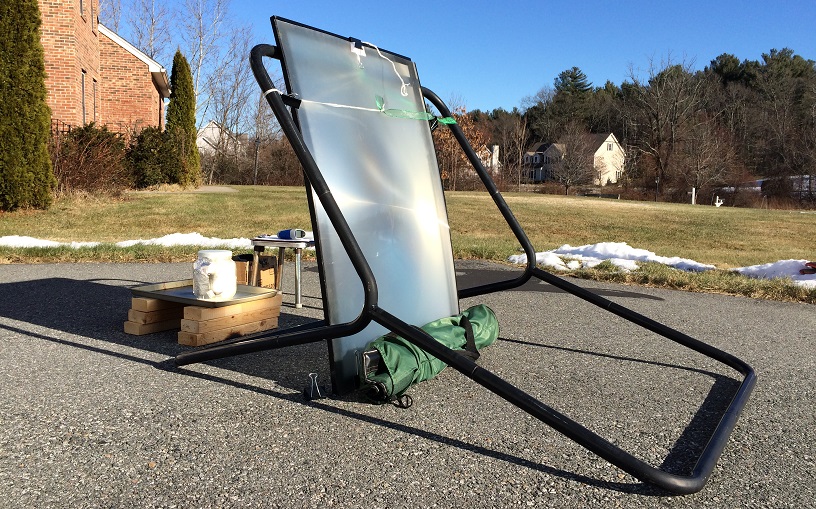
in addition to the different types of solar concentrators. To the right is my apparatus that I am used for my STEM I project.
I used the Fresnel lens to concentrate the energy of the sun to heat up sodium bicarbonate to regenerate sodium carbonate.
This process is part of the sodium carbonate cycle, which removes carbon dioxide from the air.
After 24 trials, I was able to get the sodium bicarbonate to reach a maximum temperature of 230°C. I did this by painting the jar black and putting that jar
inside a larger jar to form a mini greenhouse. While I was able to only get a maximum of 60% of the sodium bicarbonate to decompose into sodium carbonate,
I also found, through 12 more trials, that putting the sodium bicarbonate under a Fresnel lens was more efficient than putting it in a toaster over. I would like
to try this project again in the summer when the temperature is warmer and the sunlight is more intense. Here is my full paper.
To the left was my station at STEM fair.